ATIYO

ATIYO vs Asana

A creative operating system—or configurable work management?

Asana is a broad work-management platform that teams can configure for many departments and processes. ATIYO is narrower: it models the creative strategy and production loop used by founder-led ecommerce brands, from Brand Bible and roadmap through brief, asset, outcome, and retained learning.

Comparison verified from official public sources · Updated July 29, 2026

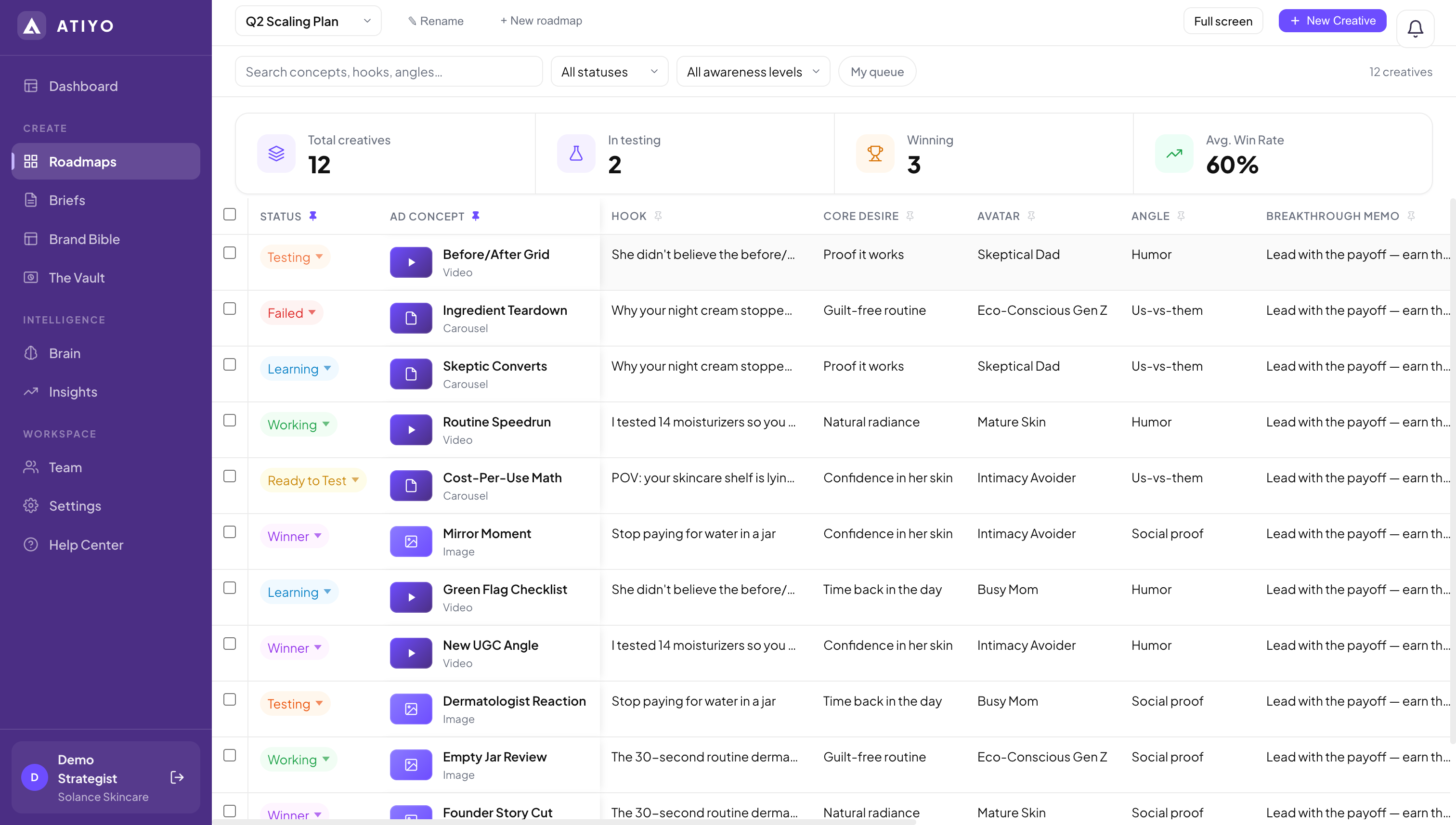
ATIYO Creative Roadmap for ecommerce concepts and production
ATIYO product view · Illustrative demo workspace

The short answer

Asana is more configurable. ATIYO is more opinionated.

Choose Asana when one flexible task and project system must support creative work alongside other company workflows. Choose ATIYO when the team wants ecommerce-specific strategy objects, structured ad briefs, creative roadmaps, assets, recorded outcomes, and learnings connected without designing that data model from scratch.

Honest positioning

Both can coordinate work, but they preserve different context.

Asana provides tasks, projects, multiple views, forms, automation, reporting, and—on eligible plans—proofing and approvals. ATIYO does not try to replace company-wide project management. It gives a creative team a purpose-built system for the marketing context that generic tasks do not represent by default.

What you need
ATIYO
Asana
Primary job
ATIYOCreative strategy and production operations for ecommerce brands, founders, strategists, creators, and editors.
AsanaGeneral work management across projects, teams, goals, workflows, and departments.
Work planning
ATIYOCreative Roadmaps organize concepts across custom production stages, products, campaigns, owners, and due dates.
AsanaAsana offers list, board, calendar, timeline, and Gantt views; availability varies by plan.
Creative intake and approvals
ATIYOStructured briefs connect strategic inputs, references, owners, due dates, assets, and review feedback.
AsanaAsana's Starter plan includes forms, while its Advanced plan includes proofing and approval workflows.
Brand and audience context
ATIYOA Brand Bible stores avatars, desires, angles, ad types, and direction for reuse across briefs.
AsanaAsana provides customizable tasks, projects, fields, and templates rather than a built-in ecommerce Brand Bible.
Creative outcomes and learning
ATIYOTeams record outcomes and learnings against creative work so the next brief can begin from retained evidence.
AsanaAsana reports on work and goals. Its official pricing page does not present an ecommerce creative-learning model.
Breadth and integrations
ATIYOFocused on creative operations. ATIYO does not replace a company-wide work-management platform.
AsanaAsana's official pricing page lists more than 100 integrations and workflows that extend across business functions.
Published starting price
ATIYO$29.99 USD per month for Starter. Review current billing details before confirming secure checkout.
AsanaAsana Personal is $0 for up to two users. Starter is $10.99 USD per user/month billed annually or $13.49 billed monthly, verified July 29, 2026.
Which one fits?

Choose based on the bottleneck—not the logo.

Choose ATIYO if

  • Your team wants a ready-made ecommerce creative data model instead of custom fields.
  • Brand Bible inputs must stay connected to roadmaps, briefs, assets, and learnings.
  • You manage multiple products, campaigns, creators, or brand workspaces.
  • Creative operations—not company-wide project management—is the bottleneck.

Asana may fit better if

  • You need one work-management platform for many departments and use cases.
  • Your team depends on a broad integration and automation ecosystem.
  • Advanced timelines, portfolios, goals, or resource-management features matter.
  • You are willing to configure the creative process using projects, fields, and templates.

A practical next step

Decide whether the missing layer is structure or flexibility.

If your team already has a reliable Asana system, ATIYO does not need to replace it. ATIYO can hold the specialized brand and creative context while Asana remains the broader company task layer. If the creative process is the only process you need to fix, ATIYO may reduce the setup required.

01

Map

List the strategy, brief, production, review, and learning fields the team needs.

02

Test

Build one real creative cycle in each candidate instead of comparing feature lists.

03

Measure

Check whether people can find context, ownership, status, assets, and decisions.

04

Choose

Keep the specialized system, configurable system, or combination the team will maintain.

Official sources

Check the facts yourself.

Competitor features, availability, and pricing can change. These are the public sources used for this comparison.

ATIYO is independent and is not affiliated with Asana. Asana is a trademark of its respective owner. Information was checked July 29, 2026 and may change.

Straight answers

Frequently asked questions

Is ATIYO an Asana replacement?

ATIYO can replace an Asana project used only for ecommerce creative operations. It does not replace Asana's broad company-wide task, goal, portfolio, reporting, resource, and integration capabilities.

Can ATIYO and Asana work together?

Yes. ATIYO can hold Brand Bible context, roadmaps, briefs, assets, outcomes, and learnings while Asana coordinates work that spans other departments. ATIYO does not claim a native Asana integration.

Which tool includes creative proofing?

Asana documents image and PDF proofing on its Advanced and higher plans. ATIYO keeps asset review and feedback in its Vault, connected to the creative workflow, but does not reproduce Asana's full proofing and approval feature set.

Use the system that keeps the right context visible.

ATIYO gives ecommerce creative work a ready-made operating model. Asana gives teams a flexible platform to build their own.

7-day trial · Starter is $29.99 USD/month afterward